• Arctic Grayling

    Northern Lights Fly Tyers/TU Edmonton has an opportunity to get involved in a project to study the Arctic Grayling.   Arctic grayling are truly a special fish, but in much of the southern portion of their range, their vulnerability to development, harvest, and changing landscapes have rendered their populations fragile and in need of special care.
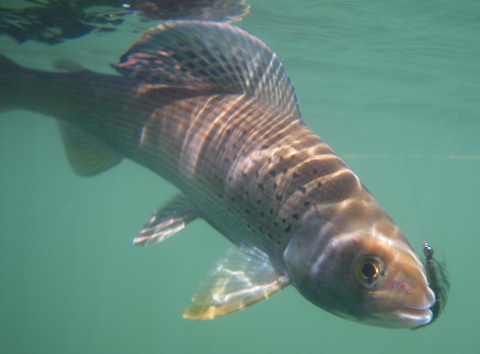
    Arctic Grayling – photo by KenM

    2012 Grant Application

    The major purpose of the project will be to update the current data base on Arctic Grayling distribution and abundance in the Upper Pembina River (UPR) watershed. The UPR watershed is roughly defined as the main river and tributaries upstream of Highway 16, but with a greater focus on waters upstream of Cynthia and Lodgepole. Historically, streams in this area provided high-quality sport fishing for residents of Central Alberta. For a variety of reasons, many of the grayling populations have been extirpated and those that remain are in a precarious state. NLFT/TUC has committed financial and in-kind support to assist SRD (Fish & Wildlife) in conserving the remaining stocks and identifying opportunities to restore former populations. Volunteers (target of 50 anglers and 50 sites for 2012) will undertake a systematic angling survey at designated sites located on 10 tributaries, and on the main Pembina River. Sites angled in 2011 (23), the first year of the survey (which was funded by NLFT/TUC) will be repeated to provide confirmation. NLFT/TUC will also install water temperature data loggers (in collaboration with SRD) to gain insight into the temperature suitability of streams in the project area (now and with Climate Change). Fifteen data loggers were purchased by NLFT/TUC in 2011 (13 installed) and an additional 15 units are being provided by this group in 2012. Temperature data collected in 2012 will be forwarded to SRD for analysis and interpretation and will be included in their Arctic Grayling status report for the project area.


    2012 Objectives

    1. To evaluate current distribution and relative abundance of Arctic Grayling in the main Pembina River and tributaries, with particular reference to stream/reaches that formerly supported populations (i.e., based on published reports, the FWMIS data base, anecdotal reports, etc.).

    2. To describe habitat conditions at sampling locations, and stream crossings used to access these sites, which will contribute to an assessment of the current potential of the UPR basin for supporting grayling.

    3. To assess water temperature regimes in the various study streams and reaches as a means of determining habitat suitability for Arctic Grayling.

    4. To collect representative fish tissue samples from Arctic Grayling in the watershed, as a contribution to the DNA profiling initiative being undertaken by the University of Alberta.

    5. To assist, through volunteer efforts, in the identification of sites and opportunities for habitat and/or population restoration in the Pembina River watershed.

    6. To identify potential sites (with adequate densities to serve as possible sources for restoration stocking) for future reference and follow-up by SRD.

    2012 Activities and Methodology

    1. Conduct a volunteer angling survey in the Upper Pembina River (mainstem and tributaries) during the spring to fall period in 2012; the survey will include re-sampling of the 23 sites angled in 2011 (to provide insight into possible year-to-year variability in capture rates and distribution patterns); the survey will be expanded to include tributaries and tributary reaches that were not sampled in 2011 (approximately 25 new sites).

    2. Record angler catch, catch rates (fish/rod h), fish length and habitat conditions on standardized data forms for transmittal to SRD and subsequent inclusion in the provincial government data base.

    3. Collect pelvic fin tissue samples for genetic analyses/DNA profiling at the University of Alberta, using a sampling and preservation protocol provided by the university investigators.

    4. Geo-reference and photograph all angling sites with a focus on identifying sites or reaches displaying high quality grayling habitat or adverse land-use issues.

    5. Monitor water temperatures in the main Pembina River and selected tributaries (Bigoray River, Paddy Creek, Rat Creek, Dismal Creek, Nelson Creek, Zeta Creek, Lovett River, Center Creek, Crooked Creek, Hanson Creek) using Onset Hobo Temp data loggers; 30 units will be installed during the period early June to mid October, 2012; the sites selected will include the 13 sites monitored in 2011 in order to gain insight into year-to-year differences in water temperature due to stream flow and weather conditions; the water temperature monitoring program will be carried out in collaboration with SRD who are planning a comprehensive electrofishing program in the Upper Pembina River watershed targeting young-of-the-year and juvenile age classes of Arctic Grayling (i.e., size classes not susceptible to angling); water temperature data will be forwarded to SRD for analyses and reporting.

    6. Evaluate stream crossings accessed during the angling survey using the Alberta Stream Crossing Assessment Protocol (Joint GoA/DFO Stream Crossing Assessment Protocol), to identify potential fish passage and erosion – sedimentation issues; SRD will provide training in the use of the protocol to the NLFT/TUC volunteers.

    7. Enumerate, measure (fork length to nearest mm) and record all other sport fish captured during the survey in addition to Arctic grayling (i.e., likely to include Northern Pike, Mountain Whitefish, Brook Trout, and Burbot, and possibly Rainbow Trout and Bull Trout);

    8. Coordinate the NLFT/TUC project with SRD fisheries staff during all phases of the project (planning, implementation, reporting) to ensure that the data collected will complement the provincial government sampling program planned for the Pembina River watershed in 2012;

    9. Provide data that can be used by SRD to identify possible relationships between water temperature regime and habitat suitability of various streams and stream reaches for Arctic Grayling (current conditions and with future Climate Change); using HOBO Temp Data Logger data from 2011 and 2012;

    2011 Arctic Grayling Symposium

    Trout Unlimited Canada, Golder Associates, and Alberta Sustainable Resource Development (Fish & Wildlife), in association with Fisheries and Oceans Canada, Department of Renewable Resources (University of Alberta), Alberta Conservation Association and the American Fisheries Society (Mid-Canada Chapter), will be hosting a two day symposium & workshop on the Conservation of Arctic Grayling.

    The event will be held in Grande Prairie, Alberta, June 7-9, 2011.  More details about the symposium can be found on the TU Canada Website.

    Volunteer Creel Survey

    A proposal is in the works to have Northern Lights Fly Tyers/TU Edmonton club members get involved in a creel survey to determine the present distribution and status of Arctic Grayling in athe Pembina River Watershed.

    A DRAFT version of the proposal follows:

    Background

    The Pembina River drainage represents the most southerly distribution of Arctic Grayling (not including stocked lake populations in Kananaskis, and a possible remnant population in the Belly River) in Alberta, and Canada. Prior to the development of the Pembina Oilfield in the 1950′s which resulted in extensive oil & gas development and a rapid increase in road access, the Pembina River and its tributaries supported high quality grayling fisheries. Several of these populations persisted well into the 1970′s and 1980′s. A smaller number of streams continued to provide grayling fishing into the 1990′s. A joint study by the Alberta Fish & Wildlife (AF&W) and the Alberta Conservation Association (ACA) in 2002 and 2003 indicated that grayling populations in the watershed had probably collapsed. Current populations, should they persist, are likely to be highly fragmented and extremely susceptible to complete extirpation.

    Purpose

    In keeping with the mission statement of Trout Unlimited Canada (“To conserve, protect & restore Canada’s freshwater and coldwater resources for current and future generations”), the Northern Lights Chapter will be attempting to determine the current distribution and population status of Arctic grayling in the Upper Pembina River mainstem and its tributaries in 2001 (possibly 2012). To achieve this, Chapter members will carry out a volunteer angling survey using a systematic and well-organized sampling approach. The sampling program will be reviewed an approved by the AF&W to ensure that the information collected can be used by provincial fishery managers to better understand the current status of grayling populations in the watershed, and assist in developing effective protection and restoration measures.

    Study Area

    The size of the study area and the level of sampling effort will depend on the number of volunteer anglers that participate in the project. For preliminary planning purposes we are basing our project on a minimum of 30 volunteer anglers, with corresponding funding support from TUC to cover equipment needs and expenses (outlined below). With this level of volunteer support it would be our intent to cover the top priority streams and stream reaches in the Upper Pembina River watershed (roughly defined as all waters upstream of Lodgepole/Sec. Highway 753). This would include tributaries such as the Lovett River, Centre Creek, Dismal Creek, Rat Creek, Nelson Creek, Paddy Creek, and several unnamed streams as well as the mainstem Pembina River. Due to the size of the area, we will focus our angling efforts on streams and reaches of streams that provide suitable habitat characteristics and have historically supported grayling populations (i.e., based on FWMIS data, previous fisheries reports and angling experiences of Chapter members).

    Sampling Approach

    Prior to the opening of the 2011 angling season (Zone ES3; streams open from June 16 – October 31; Pembina River upstream of Highway 40 opens June 16 closes August 31, downstream of Highway 40 to S.H. 753/Lodgepole opens April 1 closes October 31), Thirty stream reaches will be determined and geo-referenced (GPS coordinates) using air photos and GIS mapping procedures. Anglers will be paired for health & safety reasons, and each pair (15 pairs) will be assigned two stream reaches for survey angling during the summer field period (June 16 to August 16). Some streams and stream reaches will be scheduled for sampling during the early part of the season (e.g., small tributaries that may only support grayling during the spawning and early post-spawning period), while others will be scheduled for later in the summer (e.g., the Pembina River mainstem when during periods of lower flow).

    Volunteer anglers will be provided creel survey forms developed by the AF&W. Data recorded will include the hours fished, type of gear used, numbers and size of grayling (and other fish species) captured, location of fishing effort (GPS coordinates), water temperature, photographs of representative habitat, and an adipose fin clip to enable future genetic profiling. The information will be summarized and forwarded to the AF&W following the angling season.

    In addition to their personal fishing gear, anglers will be provided maps, clip¬boards, GPS units with previously programmed coordinates for their assigned survey locations, digital read-out thermometers, digital cameras, tape measures, and a sampling kit for clipping and storing adipose fin clips. Anglers will be expected to provide their own survival (food and water, insect repellent) and first aid gear (with the exception of bear spray and/or other bear scare devices). Health & Safety protocols and expectations will be discussed with participants, a H&S Plan will be filed for each individual trip, and a rigid call-in procedure will be adhered to.

    Estimated costs

    The volunteer anglers will be compensated for fuel used during the surveys; all other expenses will be covered by the volunteer. TUC will cover the purchase of to 5 to 10 GPS units, 20 water temperature thermometers, 5 to 10 digital cameras, 15 tape measures, and 15 sampling kits for collecting/storing adipose clips. The cost of conducting the study will depend on the number of volunteers participating but based on 30 volunteers we are anticipating the need for up to $10,000 in funding.

    Discussion

    A discussion forum about Arctic Grayling has been created in our online forum.